
Poor communication within your team can leave your team stressed and unproductive.
However, the real problem begins when poor communication among team members contributes to project delays.
So, how can you tell your team communication is poor?
The solution lies in evaluating your poor team communication.
In this article, you will learn expert-recommended ways to identify poor communication and how to fix it.
Let’s dive in.
How can you identify poor communication in the workplace?
Poor workplace communication means your team does not know what you expect from them. Moreover, individuals don’t trust each other and are afraid to speak their minds.
But how can you identify if your team is facing communication problems?
Here are the top five signs of poor team communication and ways to solve them.
1. A flood of communication
A flood of communication can take different forms. For example, overwhelming your team members with facts, figures, and stories.
When does a flood of communication usually happen?
Centre for Management and Organisation Effectiveness provides world-class performance solutions. It states that when leaders need to communicate urgently, they quickly dump large amounts of information (often unstructured).
As a result, team members may:
- Forget what was communicated (which defeats the purpose).
- Find it difficult to prioritise work assignments or tasks.
- Feel stressed out.
You can address a flood of information in a few ways:
- Put your information and tasks in priority if you’re short on time.
- Communicate your team’s three most important takeaways and specific action steps.
- Speak in person rather than via email, chat, or other written forms.
2. A lack of information sharing
CMOE provides one more significant sign of poor team communication.
It states, “When team members fail to reveal or share information that enables them to succeed. Then, team members are less likely to trust one another. In the absence of trust, team morale can suffer.”
Reasons for under sharing include:
- Self-interest: A team member may keep personal information secret to gain an advantage on a particular project or earn a promotion.
- Cultural reason: Some team members come from different office cultures that may or may not align with their current team.
Initiate frequent team discussions to facilitate communication.
In these discussions, you should include the following:
- Communicating goals and establishing a team purpose.
- Identifying and resolving any business, interpersonal or task-related issues.
- Reducing communication barriers when collaborating virtually.
3. Different personality conflicts
According to Janet Zaretsky, Co-Founder of Impact Speaking Lab:
“People working together on teams will have conflicts. Their performance will suffer. When they do not resolve their differences and are holding onto resentments.”
Janet says you should be alert to the following signs:
- Missing deadlines
- Gossiping
- Forming clans
- Complaining
You can consider administering a personality assessment to help your team members understand their styles and temperaments. You can also make them understand others’ temperaments.
4. Instances of group thinking
Avery Blank, the Senior Contributor to Forbes, says that your make decisions that align with others, it’s either because they want a particular outcome (i.e., they have an agenda) or because they value harmony.
Although groupthink is common, it can have a far-reaching impact. In turn, this can lead to poor decisions.
According to Avery, there are a few ways to avoid groupthink:
- Playing devil’s advocate: You should ask lots of questions to get others to think.
- Question typical outcomes: You can encourage your team members to explore new possibilities.
- Challenging your thoughts to gain self-confidence: It’s easier to express your opinions to others when you’re more confident.
5. Instances of finger-pointing
Serenity Gibbons, Principal at Diversity and Purpose, says, “If your team members often blame one another for missed deadlines, poor results, or cultural issues, they are not communicating effectively within the company.”
Gibbons recommends asking each team member when they felt others let them down.
“You will usually hear about instances when they wish their coworkers had informed them of changes or needs before time-sensitive tasks became urgent,” says Gibbons.
An easy way out of this issue is to encourage your employees to use collaboration tools like Talk Magnet, among other best team communication apps for enterprises and SMEs.
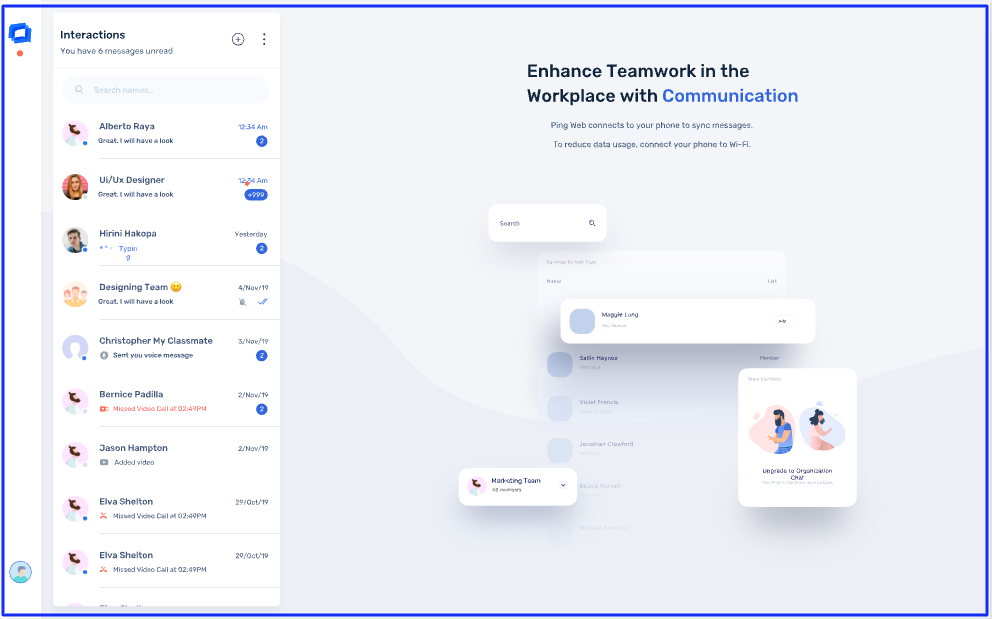
Smooth communication within your team will decrease any blame-shifting when it comes to accountability.
Eliminate poor communication in your team with Talk Magnet
Smooth and robust team communication centres around fostering clarity, collaboration, and active listening.
Talk Magnet not only helps you ensure seamless communication within your team but also lets you keep an eye out for signs of poor communication.
Talk Magnet is an easy-to-use collaboration app that lets you share files, send instant messages, and make one-on-one or group calls.
So, what are you waiting for? Book a demo today or sign up for free with Talk Magnet to ensure a smooth team communication process.


